
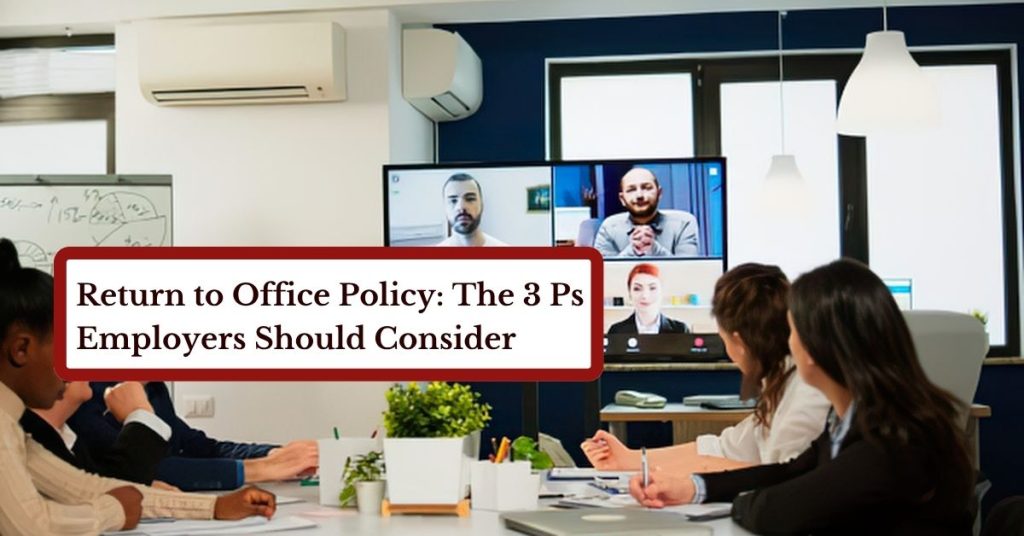
A return-to-office policy is moving higher up the agenda for many Irish employers as businesses take a more structured approach to hybrid working. New research from William Fry found that 34% of large employers currently require employees to attend the office for a fixed number of days, with that figure expected to rise to 50% by 2027. However, this is not necessarily a story about employers abandoning hybrid working. It is a story about hybrid working growing up.
For employers, there can be very good reasons to want people together more often. Collaboration, mentoring, training, client service, innovation and company culture can all benefit from people spending meaningful time together. Equally, flexibility can help businesses recruit and retain experienced people, support productivity and respond to the realities of modern working life.
As Ronan Berry, Managing Partner at HRConsultants.ie, explained when discussing the issue recently on Midlands Today, employers considering changes to office attendance should think about three Ps: Purpose, Policy and Process.
Those three questions can help an employer move beyond simply asking, “Can we bring people back?” and instead consider, “Why are we doing it, what should the arrangement look like, and how should we implement it?”
Why Are More Employers Asking People Back to the Office?
Hybrid working is not disappearing in Ireland, but employers are becoming more deliberate about how it operates. The 2026 William Fry Future of Hybrid Work research, conducted by Ipsos B&A among 404 Irish businesses, found that large employers are significantly more likely than smaller businesses to offer hybrid working. Among employers operating a hybrid model, three days in the office is the most common arrangement. Productivity was identified as the biggest influence on hybrid working policies, while accountability and collaboration were particular challenges for larger employers.
What is particularly interesting is what the research does not show. William Fry reports that just 4% of larger businesses expect a complete return to the office within two years. This suggests that the direction of travel is not simply back to five office days. Instead, many businesses are moving from relatively unrestricted flexibility towards a more structured hybrid model.
That is an important distinction when reviewing a return-to-office policy. An employer might decide that three office days make sense. Another may choose two coordinated team days. Some businesses or roles may need employees present five days a week, while others may be able to offer considerably more flexibility. The important thing is that the arrangement has a clear business rationale.
Why Being Together Can Still Matter
There are aspects of working life that can be difficult to replicate remotely. Informal conversations, observing experienced colleagues, mentoring a new employee, solving problems together and building relationships across teams can all benefit from face-to-face interaction.
Research involving more than 61,000 Microsoft employees found that firm-wide remote working made collaboration networks more static and siloed, with fewer connections between different parts of the organisation. The researchers also observed a shift away from synchronous communication towards more asynchronous communication.
This is particularly relevant for employers concerned about newer employees. An experienced person who knows the organisation, understands their role and has an established internal network may need less face-to-face support than someone at the beginning of their career or new to the business.
There is, therefore, nothing unreasonable about an employer concluding that more time together would benefit the business. But if collaboration, mentoring or training is the purpose, the office days should be designed to deliver it.
As Ronan puts it:
“The office has to earn the commute.”
If an employee travels an hour to the office only to sit at a desk on Teams calls all day, it is reasonable to ask what that office day has achieved. Presence and productivity are not automatically the same thing.
What Does Irish Law Say About Returning to the Office?
Before making changes to a return to office policy, employers need to understand the legal and contractual position.
Irish employees have a statutory right to request remote working. This should not be confused with an automatic statutory right to work remotely. The Workplace Relations Commission’s Code of Practice provides practical guidance on how employers and employees should manage requests for remote and flexible working, including situations where changes are sought to an agreed arrangement.
However, that does not mean an employer should assume that every long-standing homeworking arrangement can simply be changed overnight.
What If an Employee Has Worked From Home Since 2020?
Consider an employee who started working from home five days a week during COVID-19. Six years later, they are still working from home. Their original employment contract identifies the office as their place of work, but no formal hybrid working policy was subsequently introduced.
Does six years at home automatically give that employee a statutory right to continue working remotely? No.
But employers should not necessarily jump from that answer to: “It isn’t in the contract, so everybody is back in the office on Monday.”
Six years is a substantial period in an employment relationship. Before making a significant change, employers should review the individual circumstances, including:
- What does the original contract say about the employee’s place of work?
- What was communicated when homeworking began?
- Was the arrangement described as temporary or discretionary?
- Was anything subsequently agreed in writing?
- Has the arrangement operated consistently for several years?
- Were recruitment, promotion or other employment decisions made on the understanding that the employee would work remotely?
- Could subsequent agreement, contractual variation or custom and practice be relevant?
- Has the employee made, or might they make, a statutory request for remote or flexible working?
Ronan summarises the issue well: six years working from home does not automatically give someone ownership of their kitchen table as their permanent workplace, but an employer cannot necessarily pretend those six years never happened either. The contractual history and the reality of the working arrangement need to be examined.
This is also where getting advice before acting can prevent unnecessary problems. HRConsultants.ie supports employers through outsourced and retained HR services, including reviewing employment contracts, policies and existing working arrangements before significant workplace changes are introduced.
Consider the Wider Impact of Your Return to Office Policy
The legal question matters, but it should not be the only question. Even where an employer has the contractual ability to increase office attendance, it is worth considering the wider commercial consequences of the decision. A return to office policy can affect recruitment, retention, employee engagement, management, productivity and the organisation’s ability to compete for particular skills.
This does not mean flexibility should always win. It means employers should understand the potential benefits and costs of the decision they are making.
Recruitment and Retention
For some candidates, hybrid working has become an important part of choosing one employer over another. This can be particularly relevant in competitive sectors where employers are trying to attract experienced or difficult-to-find skills.
There is also good evidence that hybrid working can support retention. A randomised controlled trial involving 1,612 graduate employees at Trip.com compared employees working from home two days a week with employees working in the office five days a week. The hybrid group experienced improved job satisfaction and approximately one-third lower quit rates, with no evidence that hybrid working damaged performance ratings or promotions.
That does not prove that two home days are right for every employer. The study involved particular types of graduate employees at one technology company, so employers should be careful about applying its findings universally. What it does demonstrate is that flexibility can have measurable commercial value.
Parents, Carers and Experienced Employees
The arrival of children can be one of the biggest changes in a person’s working life. Suddenly, childcare, school runs, commuting, illness and family logistics all have to fit around the working day.
From an employer’s perspective, this is not simply a matter of employee convenience. It can become a retention issue.
An experienced employee may have spent years building knowledge of your customers, systems, processes and team. If some degree of flexibility helps that person remain with the organisation rather than reducing their hours or looking elsewhere, the employer may receive considerable value in return.
As Ronan explained during his radio discussion:
“Flexibility isn’t necessarily something an employer gives away. It can be something they get value back from.”
That is why a return to office policy should be considered as part of the wider people strategy rather than purely as an attendance issue.
Fair Does Not Always Mean Identical
There is another reality employers need to acknowledge. Remote working simply is not possible in every job.
A nurse, factory operative, retail employee, construction worker or hospitality employee cannot necessarily perform their role remotely. That does not mean employers must provide identical arrangements across completely different jobs.
Fairness does not always mean treating every role in exactly the same way. Employers should instead have clear, rational and transparent reasons for why particular roles or teams can work remotely while others require greater physical attendance.
The 3 Ps of a Successful Return to Office Policy
So, how should an employer approach the issue?
Ronan recommends starting with a three-pronged approach:
Purpose, policy and process.
The strength of the 3 Ps is that they do not start from the assumption that employees should be in the office or at home. They start with the needs of the organisation and provide employers with a framework for making and implementing a considered decision.
P1: Purpose: Why Do You Want People in the Office?
Before deciding whether employees should attend two, three, four or five days each week, ask a more fundamental question:
Why do we want them there?
There could be several sound business reasons:
- Better collaboration between teams
- Training and development
- Mentoring younger or newer employees
- Improving communication
- Client service
- Creative or innovation work
- Building stronger relationships
- Strengthening organisational culture
- Addressing specific performance or operational concerns
But there can also be less convincing reasons:
- “Other companies are bringing people back.”
- “Three days seems to be what everyone is doing.”
- “Senior management prefers seeing people at their desks.”
- “We have an office, so we should be using it.”
- “We don’t really know what people are doing at home.”
- “Our managers are struggling to manage remote teams.”
- “It was never meant to last this long.”
- “We just think people are more productive in the office.”
Those concerns should not simply be dismissed, but they need to be examined. For example, if managers are struggling to manage remote employees, is the problem really where people are working, or do those managers need better systems, clearer performance measures or additional management training? If there are concerns about productivity, what evidence is showing that productivity has fallen? If the concern is culture, what specifically will happen when people are together that will strengthen that culture?
Likewise, wanting to see people sitting at their desks is not the same as having a clear business reason for office attendance. Presence is not the same thing as productivity.
This is why Purpose comes first. An employer may ultimately conclude that the business works better when employees spend more time together, and that is a perfectly legitimate conclusion. But the number of office days should flow from what the business is trying to achieve rather than from what competitors are doing or a general feeling that people should be back.
If collaboration is the purpose, coordinate office days so people are actually together. If mentoring is the purpose, make sure experienced and junior employees attend at the same time. If productivity is the concern, identify what has changed and determine whether office attendance is likely to improve it.
The key is being able to articulate the reason for the change. If an employer cannot clearly explain why increased office attendance is necessary and what it is expected to improve, that is a sign that the decision may need more thought. A good return to office policy should start with a defined business need, not simply a preference for how things used to be.
P2: Policy: What Does Hybrid Working Mean in Your Organisation?
Once you are clear on the purpose, the second P is Policy. This is about more than simply having a written hybrid or return-to-office policy sitting in the employee handbook. Employers first need to establish what hybrid working actually means within their organisation and make sure everyone understands the rules.
For example, does hybrid working mean employees can choose when they come into the office, or are there fixed attendance days? Are there particular days when whole teams need to be together? Is the arrangement available to everyone, or only to roles that can reasonably be performed remotely? What are the expectations around performance, availability and working hours when someone is working from home?
These questions need clear answers. A good policy should therefore establish:
- Which roles are eligible for hybrid working
- How many days employees are expected to attend the workplace
- Whether there are fixed, core or team attendance days
- How remote working requests are made and considered
- Performance expectations and how performance will be measured
- Working hours, availability and communication expectations
- Equipment and responsibility for the home workspace
- Confidentiality and data protection requirements
- Health and safety considerations
- The right to disconnect
- How hybrid arrangements will be reviewed
- How changes to existing arrangements will be handled
- What happens when the needs of the business change
The Workplace Relations Commission’s Code of Practice is particularly relevant here. It provides guidance for employers and employees on making and considering requests for remote working, as well as dealing with changes to an existing remote working arrangement. Employers should therefore make sure their own policies and procedures work alongside the statutory framework rather than treating hybrid working as an entirely informal arrangement.
Consistency also matters. If one manager allows their team complete flexibility while another applies the return-to-office policy rigidly, employers can quickly create confusion and frustration. Managers need to understand not only what the policy says, but how it should be applied fairly and consistently while still allowing individual circumstances and legitimate business requirements to be considered.
This is an area where HRConsultants.ie works directly with employers. Through our outsourced and retained HR services, we can help businesses establish what hybrid working should look like in practice and then develop or review the policies, contracts and HR procedures needed to support it. The objective is not simply to have a policy on paper, but to have an arrangement that is clear, workable and appropriate for the business.
P3: Process: How Will You Introduce the Change?
The third P is Process, and this can determine how smoothly a change is implemented. Imagine two employers reaching exactly the same conclusion that employees should attend the office three days a week. The first sends an email on Friday afternoon stating that everyone must attend three days from the following Monday. The second reviews existing contracts and arrangements, establishes its business reasons, considers the WRC framework, speaks to employees, considers individual circumstances, explains what office days are intended to achieve, provides appropriate notice and documents the new arrangements clearly. The destination may be similar. The process is very different.
When changing a long-standing arrangement, employers should consider:
- Reviewing the contractual history. Understand what was originally agreed and what has happened since.
- Explaining the business rationale. Employees should understand why greater attendance is being introduced.
- Consulting appropriately. Listen to relevant concerns and practical issues rather than assuming they do not exist.
- Considering individual circumstances and statutory requests. Different employees may have different situations that require proper consideration.
- Providing reasonable notice. People may have organised childcare, transport and other commitments around established working arrangements.
- Documenting the outcome. Everyone should understand what has ultimately been agreed or required.
The WRC Code is important here. It provides guidance on making and managing remote working requests, including changes to agreed arrangements, and the Code is admissible in evidence in proceedings before a court, the Labour Court or a WRC adjudication officer.
A well-managed process does not prevent an employer from making a commercial decision. It helps the employer make and implement that decision properly.
There Is No Perfect Number of Office Days
Employers understandably want certainty. It would be convenient if research could tell every business that two, three or four days in the office is the perfect answer. It cannot!
Different jobs benefit from different working arrangements. Different businesses have different customers, cultures, technologies, management structures and operational requirements. Even within the same organisation, the best arrangement for a new graduate may differ from the arrangement that works for an experienced specialist.
Research also shows why simple claims about office versus remote productivity should be treated cautiously. The Trip.com randomised trial found hybrid working improved retention without damaging performance, while Microsoft research identified potential challenges around collaboration and information sharing during firm-wide remote working. Both can be true at the same time.
That is why employers need to move beyond the argument about whether office working or remote working is universally “better”. The more useful question is which work is better done together, which work can be done effectively remotely and how the organisation can get the best from both.
That brings us back to the 3 Ps:
Purpose determines why, policy establishes what and process determines how.
Key Takeaway: Make Your Return to Office Policy Deliberate
Hybrid working is growing up. The emergency arrangements introduced during COVID have evolved, and employers are now making more deliberate decisions about where and how work should happen.
For some businesses, that will mean increasing office attendance. For others, existing hybrid arrangements may continue to work well. There is no reason to villainise an employer for deciding that its people need to spend more time together, just as offering flexibility should not automatically be viewed as putting employee preferences ahead of business needs.
The strongest return to office policy is one built around the needs of the individual organisation.
Before deciding on the number of days, establish your Purpose. Before introducing the arrangement, make sure your Policy is clear. Before implementing a change, get the Process right.
If your business is reviewing hybrid working or considering bringing employees back to the office more frequently, HRConsultants.ie can help you assess the contractual, legal, practical and people implications before you make the change. Our services include outsourced and retained HR, recruitment, outsourced payroll and employment permit services, giving employers access to practical HR expertise without needing to build every capability in-house. Speak to our team today to see how we can help you.
Return to Office Policy FAQs
Can an employer make employees return to the office in Ireland?
Whether an employer can require an employee to return to the office will depend on the circumstances, including the employee’s contract, place-of-work provisions and what has subsequently been agreed or established. Employees have a statutory right to request remote working, rather than an automatic statutory right to work remotely. Employers considering a change should review the individual contractual position and follow an appropriate process.
Do employees have a legal right to work from home in Ireland?
There is no general statutory entitlement for an employee to work remotely simply because their job can be performed from home. Employees do have a statutory right to request remote working, and employers should deal with those requests in accordance with the relevant legislation and WRC Code of Practice.
Can an employer change an existing hybrid working arrangement?
Potentially, but employers should establish the basis on which the existing arrangement operates before making changes. Contracts, subsequent correspondence, policies, the duration and consistency of the arrangement, and the circumstances in which it was introduced can all be relevant. Long-standing arrangements should not simply be assumed to have no significance because they do not appear in the employee’s original contract.
Does working from home since COVID give an employee permanent rights?
Not automatically. An employee who has worked from home since 2020 does not gain a general statutory right to permanent remote working simply because the arrangement has continued for several years. However, the history of the arrangement may be important, so employers should review what was agreed, communicated and consistently practised before changing it.
How many days should employees work in the office?
There is no single number that is right for every organisation. William Fry’s 2026 research found three days to be the most common arrangement among surveyed hybrid employers, but employers should choose attendance requirements based on their business needs rather than simply following the most popular model.
What should a return to office policy include?
A return to office policy should clearly explain who it applies to, expected attendance, any team or core days, working hours, performance expectations, how remote working requests are considered, confidentiality and data protection requirements, equipment, review arrangements and what happens if business requirements change.
Most importantly, the policy should have a clear purpose behind it. If employers know why they want people together, establish a clear policy and follow a considered process, they are far better placed to create a working arrangement that supports both their people and the needs of the business.